
A drone-in-a-box for the Greenland ice sheet: GAMB2LE and AURORA
Case study — arctic-hardened autonomous drone operations for AURORA, an atmospheric observatory on the ice sheet. Part of our GAMB2LE work under ARIA's Forecasting Tipping Points programme.
How the Greenland ice sheet melts depends, in large part, on the clouds above it and on the way heat and moisture move between the ice and the air. Those interactions are badly under-observed — the ice sheet is one of the hardest places on Earth to keep an instrument running. GAMB2LE is about changing that: putting an advanced atmospheric observatory onto the ice, and keeping it working.
AURORA: an observatory on the ice
The observatory is called AURORA. It brings several instruments to bear on the same patch of sky — cloud radar, lidar and a microwave radiometer working together to study clouds and ice–atmosphere interactions in detail. What those ground-based instruments can't do on their own is sample the air directly. That's where the drones come in: flying routine thermodynamic profiles — temperature, humidity, pressure and wind through the lower atmosphere — and taking an in-situ look at cloud microphysics with a new drone-mounted holographic aerosol imager we're helping to develop, which images the actual particles and droplets a cloud is made of.
Our job: a drone-in-a-box that survives the ice
Menapia's task is to make those drone flights happen on their own, for a whole season, somewhere brutal. That means a drone-in-a-box — an automated dock and aircraft — engineered for long-term seasonal operation on the Greenland ice sheet. Two problems dominate.
Arctic-hardening. The dock and everything around it has to launch, charge, shelter and recover an aircraft through deep cold and ice. We've already taken a dock to −50 °C in a controlled chamber to map exactly what it can do and how our modifications perform — that validation has its own post.
Propeller icing. Ice on a spinning blade can halve a drone's thrust within minutes, so we're attacking it on three fronts at once:
Icephobic coatings — tested head-to-head under controlled icing in the Cranfield wind tunnel (below);
Local forecasting — knowing when icing conditions are coming;
Tactical detect-and-avoid — algorithms that recognise the onset of icing in flight and get the aircraft clear.
Testing coatings at Cranfield
You can't study icing reliabl in the field, so we took it to Cranfield University's icing wind tunnel, which holds a chosen wind speed, temperature and cloud liquid-water content (how much water the cloud carries) while you run propellers through it. We built an instrumented rig — two test stands logging each propeller's RPM and power draw, with a MetSensor recording conditions — and ran coated blades against uncoated ones under identical icing at around −10 °C and 10 m/s.
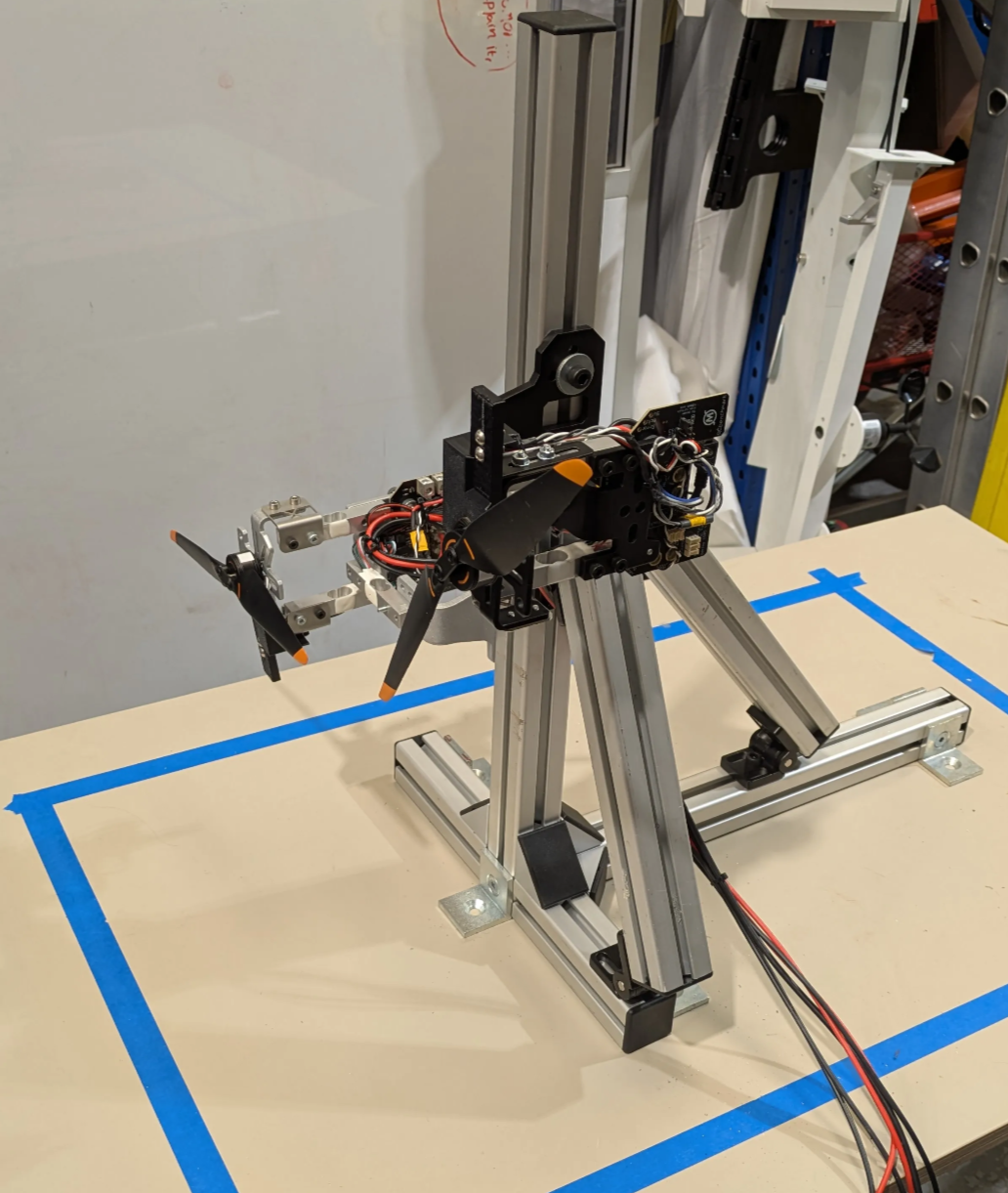
the Menapia propeller test rig built for the Cranfield icing-tunnel campaign
Under severe icing, ice builds almost immediately: the power traces diverge within moments and don't recover — a blunt demonstration of how fast an unprotected rotor stops flying. More usefully, the rig now lets us put any coating in front of identical icing and measure how much longer it keeps a propeller turning — the data we need to choose a coating, and to know when conditions are simply beyond one.
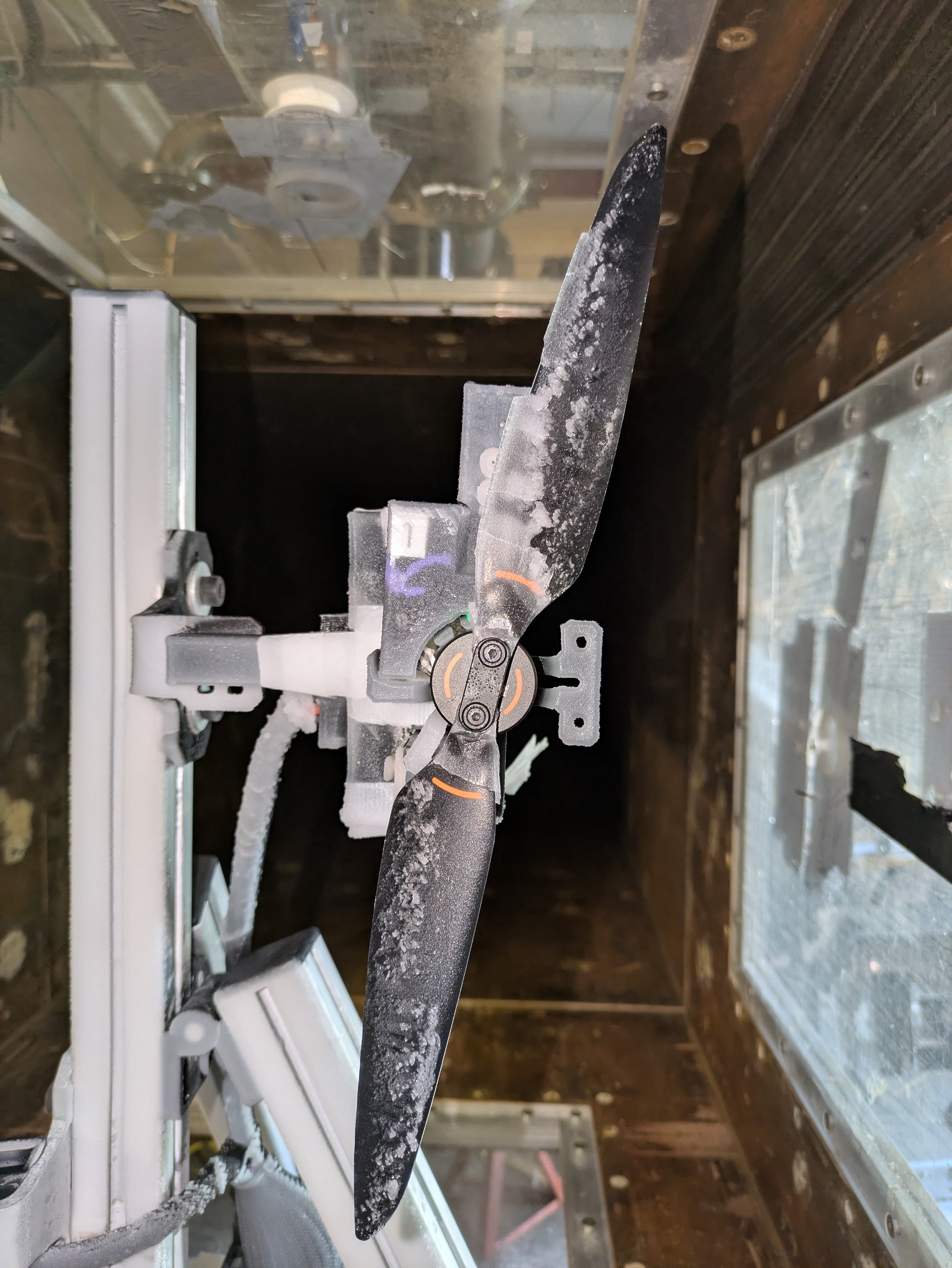
a propeller after a sustained icing run in the Cranfield tunnel: rime ice has built along the blades. Ice chunks have shed differently on each side, leading to propeller imbalance.
Powered by the sun, run from the UK
An observatory on the ice needs power that doesn't depend on anyone being there. Our partners at NCAS are developing the AURORA Power System — a solar-and-battery supply that will run the whole observatory, Menapia's docks included. And the people don't need to be there either: Menapia will operate the docks remotely from the UK, returning atmospheric and visual data in real time and working with the NCAS team to get the best science out of every flight.
First stop: Iceland
AURORA won't go straight to Greenland. It will first be deployed and proven at Menapia's Icelandic Test Facility on the Snæfellsnes Peninsula — the same site where we've begun standing up the instruments, starting with the lidar. A full account of the AURORA deployment will follow. For now, the ice sheet has a working observatory heading its way, and the drones that will fly from it are being built to last the season.
GAMB2LE is delivered with NCAS and partners under ARIA's Forecasting Tipping Points programme. [CONFIRM partner naming (NCAS, AURORA) and any detail to keep general; coating specifics kept general pending the Cranfield NDA position.]