
Down to −50 °C: proving the drone dock at Sheffield's LVV
Case study — environmental validation of our autonomous drone dock. University of Sheffield Laboratory for Verification and Validation, 2025–26. Part of our GAMB2LE work under ARIA's Forecasting Tipping Points programme.
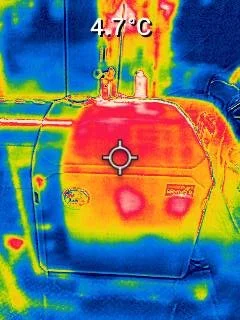
We froze a working drone dock to −50 °C, pulled its power overnight, and waited to see whether it would wake up. It did.
That test mattered because an automated dock is a promise: leave it on a remote site and it will launch, fly, recharge, shelter and recover an aircraft on its own, for weeks. In the cold places where atmospheric measurements are scarcest — the environments our GAMB2LE work is aimed at — that promise gets tested hard. So before trusting a dock to a glacier, we took it somewhere we could turn the cold up to the worst it will ever see, on demand.
The challenge
You can't characterise cold-weather performance by waiting for cold weather. We needed to know, precisely: how cold can the dock get and still charge a battery and launch a drone? How long does it take to revive a frozen aircraft? And what breaks first? Those are questions for a controlled environmental chamber, not a field trial.
What we did
We took the dock to the University of Sheffield's Laboratory for Verification and Validation (LVV), whose environmental chamber can hold the whole system at extreme, stable temperatures — including overnight cold soaks with the power pulled, to test recovery from a true cold start. We stepped the temperature down in stages, with icing and wind tests along the way, all the way to −50 °C.
What we found
The headline: the dock survived and fully recovered after overnight soaks at both −30 °C and −50 °C. Along the way we mapped its real cold-weather envelope:
Heating power. Below about −12 °C the heater runs continuously, drawing on the order of 550 W — the number you need to size power and fuel for a remote site.
Reviving a frozen drone. From a −30 °C cold soak it took roughly 55 minutes to warm the aircraft's battery to a safe launch temperature.
The launch envelope. To charge, the dock interior has to be above +5 °C and the battery above +10 °C. On that basis, routine flights could be launched in ambient temperatures as low as around −40 to −45 °C.
Power-loss behaviour. We tested what happens when the mains is cut — how long the backup carries the dock, and how deep cold shortens that — so an outage doesn't become a lost aircraft. Spoiler — our planned battery upgrade will be essential!
The failures worth finding indoors. The dock's external temperature sensor reads several degrees off in the cold; ice on surfaces and vents could stop the lid closing until it warmed. Far better to learn that in a chamber in Sheffield than on a mountainside.
Why it matters
That's the value of a chamber: you find the limits on your own terms, not the weather's. It's the other half of running a remote, unattended site — we can both operate one and prove the hardware that makes one survivable. Everything we learned here feeds straight into the next iteration of the dock upgrades.
We’ll test the new upgrades later this summer, stay tuned!
Conducted at the University of Sheffield Laboratory for Verification and Validation (LVV). [CONFIRM dock naming and LVV credit before publish.]